






As artificial intelligence moves from pilot projects into banking, healthcare, education and public services, one question matters more than any benchmark: can people trust it? Responsible AI is the answer organisations are now expected to give, with evidence. In India, where AI systems can reach hundreds of millions of people at once, that expectation is only growing.
Key takeaways
- Responsible AI rests on three ideas: trust, transparency and accountability.
- MeitY’s India AI Governance Guidelines (November 2025) build on existing laws rather than a separate AI statute, anchored in seven guiding sutras.
- The DPDP Rules make accountability enforceable: full compliance by May 2027 and penalties of up to ₹250 crore.
- Responsible AI works when engineers, product, leadership and legal share ownership from the first design discussion.
What Responsible AI Actually Means
Responsible AI is the practice of designing, building and deploying AI systems that are fair, safe, explainable and accountable to the people they affect. It is not a single tool or a compliance checkbox. It is a set of habits: testing for bias before launch, documenting how a model reached a decision, protecting personal data and giving people a way to challenge outcomes.
Three ideas sit at its core:
- Trust. People will only adopt AI-driven services if they believe the systems are reliable and treat them fairly.
- Transparency. Users and regulators should know when AI is being used, what data feeds it and what its limits are.
- Accountability. When something goes wrong, a specific person or organisation must be answerable.
India’s Policy Foundation
India has chosen to guide rather than rush into a single sweeping AI law. In November 2025, MeitY released the India AI Governance Guidelines, which do not create separate AI legislation but build a framework on existing laws, institutional oversight and phased regulatory development. The framework rests on seven guiding sutras and recommends new institutions, including an AI Governance Group, a Technology and Policy Expert Committee and an AI Safety Institute.
That matters for anyone practising responsible AI, because it sets expectations without freezing innovation. The government has also said it will act swiftly, even with stricter law, if urgent regulation is needed. Organisations that build good habits now will be better prepared if rules tighten.
Related: AI Governance in India 2026: Policies, Opportunities and the Road Ahead
Data Protection: The Hard Edge of Accountability
AI runs on data, and India’s data protection regime is where accountability becomes enforceable. The Digital Personal Data Protection Rules were notified on 14 November 2025 after consultation that drew 6,915 inputs, with an eighteen-month phased compliance period. For AI systems that process Indian personal data, that points to full compliance by May 2027, with penalties of up to ₹250 crore for violations.
The consent requirements are especially relevant. Notices must be in plain language, available in all 22 scheduled languages, and consent must be free, specific, informed and unambiguous. For teams training or deploying models on personal data, this means knowing exactly what data you hold, why you hold it and whether people have genuinely agreed to its use.
Building the Three Pillars in Practice
Trust through reliability and fairness
Test models on India’s real diversity: languages, dialects, regions, income levels and accessibility needs. A model trained mostly on urban, English-language data can fail quietly for everyone else. Regular bias audits and performance monitoring after launch, not only before, are essential.
Transparency through disclosure and documentation
Tell users when they are interacting with AI. Keep model documentation covering training data sources, known limitations and intended use. Where decisions affect people’s lives, such as loan approvals or hiring, provide plain-language explanations of the factors involved.
Accountability through ownership and redress
Assign clear responsibility for each AI system, ideally to a named role with authority to pause or retire it. Create simple channels for users to report harm or contest decisions, and maintain incident logs so problems are learned from rather than buried.
Why Forums and Conferences Matter
Responsible AI is still being defined, and shared learning speeds it up. A responsible AI conference brings together policymakers, engineers, researchers and civil society to compare what actually works. India’s hosting of the AI Impact Summit in New Delhi underlined this. It was billed as the first global AI summit hosted in the Global South, giving developing economies a stronger voice in setting norms. For practitioners, these events are where case studies, audit methods and sector-specific lessons get exchanged before they harden into regulation.
Challenges That Remain
The road is not smooth:
- Audit resources. Many startups and small businesses lack the resources for formal audits.
- Regulatory talent. Regulators need technical talent to evaluate complex systems.
- Deepfakes. Deepfakes and synthetic media continue to test the limits of platform rules.
- Coordination. Effective AI governance across multiple ministries and sector regulators requires coordination that is easy to promise and hard to deliver.
There is also a cultural challenge. Responsible AI fails when it is treated as a legal department’s problem. It works when engineers, product managers, leadership and legal teams share ownership from the first design discussion.
A Practical Starting Checklist
- Inventory every AI system in use and the data it touches.
- Classify systems by the risk they pose to individuals.
- Run bias and robustness tests on representative Indian data.
- Update privacy notices and consent flows to match DPDP requirements.
- Assign an accountable owner and publish a simple redress process.
- Review everything on a regular schedule, not once.
The Road Ahead
India’s approach, which combines principle-based guidance, data protection law and growing institutional capacity, gives responsible AI a workable foundation. The organisations that will earn public confidence are those that treat trust as something built through transparency and accountability, not claimed in a press release.
In a country where AI can extend services to millions who were previously left out, getting this right is not just a compliance exercise. It is how the technology earns its place in everyday life.
Trust is built through transparency and accountability, not claimed in a press release.
Where the Conversation Continues: Gujarat AI Summit 2026
The shift toward responsible, well-governed AI is not something any one organisation can work out alone. It takes policymakers, technologists, researchers and industry leaders in the same room, comparing notes on what is working and what is not.
That is what makes the Gujarat AI Summit 2026 worth watching. The agenda covers many of the themes this post has explored: AI governance, digital infrastructure, data security, research and responsible AI. For anyone building or regulating AI in India, these are the questions that will shape the next phase.
Whether you are a founder trying to make compliance practical, a policy professional tracking how guidelines turn into practice, or a developer who wants to build trust into your systems from day one, the summit offers a chance to learn from peers and see where the conversation is heading.
Join the conversation in Gandhinagar
Learn from policymakers, technologists and industry leaders working on AI governance, data security and responsible AI.
Register for the Gujarat AI Summit 2026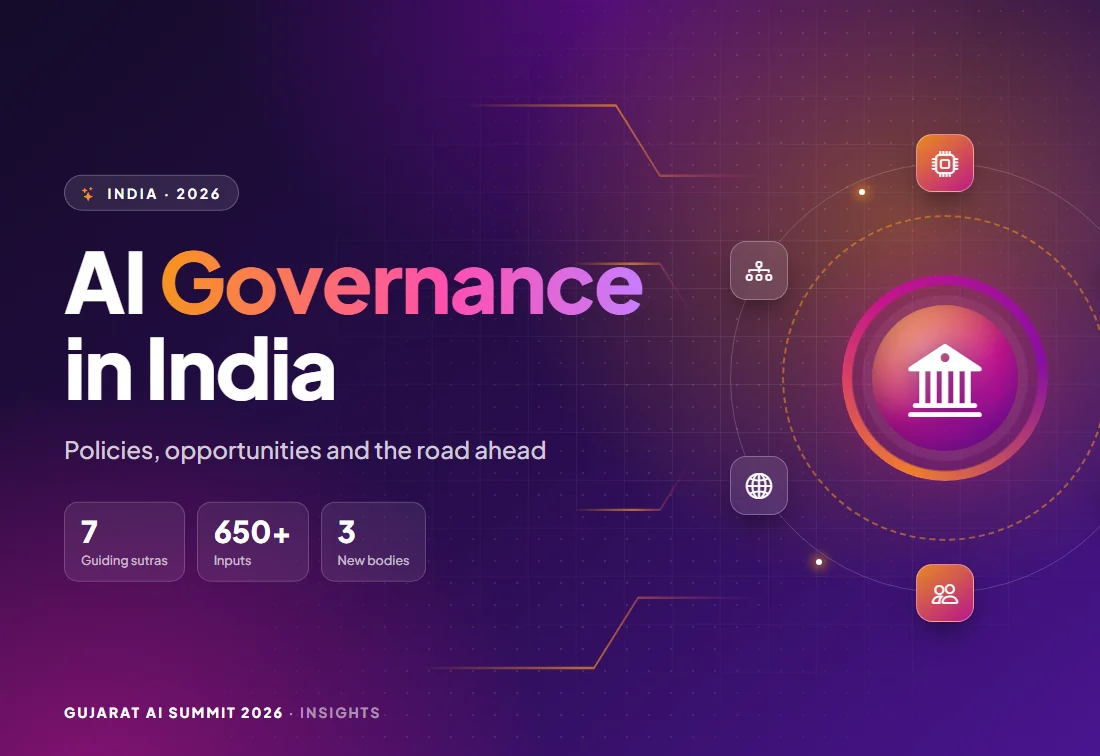 Read nextAI Governance in India 2026: Policies, Opportunities and the Road Ahead