






Walk through an Indian bank, a car plant, a hospital or an online store today, and you will find AI quietly at work: flagging suspicious transactions, spotting defects on a production line, speeding up diagnostics, and recommending the next product. AI digital transformation is no longer a future plan for Indian businesses. It is a daily operating reality, though one that is unfolding at very different speeds across sectors.
Key takeaways
- Nearly half of Indian firms have already deployed multiple AI use cases in production.
- BFSI, manufacturing, retail, healthcare and logistics are each using AI in different ways and at different speeds.
- AI is stalling on readiness, not capability: inconsistent data, integration debt and weak ROI measurement.
- The winners will pair AI tools with clean data, early governance, skilled people and honest outcome tracking.
A Market Past the Experiment Stage
Indian organisations are adopting AI faster than many expect. A joint EY and CII survey covering over 200 organisations across more than 20 sectors found that nearly half of Indian firms have already deployed multiple AI use cases in production. A separate regional study points the same way: 63% of Indian organisations use AI assistants and chatbots, the highest rate among the APAC markets surveyed, and none of the Indian organisations covered reported operating without AI tools.
The picture is not all upside, and the same research flags a gap between enthusiasm and spending. Headlines about enterprise AI often skip over that tension: strong adoption but cautious budgets and difficulty proving financial returns.
Related: Enterprise AI in 2026: From Experimentation to Real Business Transformation
How Different Industries Are Using AI Technology
Banking and financial services
BFSI is among the most visible adopters, using AI for risk assessment, predictive lending and regulatory compliance. Practical entry points include KYC preparation, claims summarisation and customer query documentation. The sector is also growing its talent base quickly: AI roles in BFSI grew 41% year on year.
Manufacturing
Factories are starting to run on models as well as machines. Automotive currently dominates AI use in Indian manufacturing, followed closely by pharmaceuticals and electronics. Typical applications include quality inspection, predictive maintenance and production optimisation. One estimate projects India’s AI-in-manufacturing market reaching roughly $4.89 billion by 2030, growing at a 41.5% compound annual rate. Projections like this vary by research firm, so treat them as directional rather than precise.
Retail and consumer goods
Personalisation is the headline use case. AI-driven personalisation contributes to nearly one-third of online sales in retail. Behind the scenes, retailers are also using AI for catalogue cleanup, returns classification and customer-experience triage.
Healthcare
Hospitals and pharma companies are adopting AI for diagnostics and clinical workflows. One industry report notes that AI tools are reducing diagnostic errors by up to 20% and speeding up clinical workflows. Hiring tells the same story, with healthcare and pharmaceutical AI roles growing 38% year on year.
Logistics and transport
A sector that barely featured in AI conversations a few years ago is catching up: logistics AI hiring grew 30% year on year, reflecting use cases in routing, demand forecasting and fleet management.
The Barriers Holding Industry Back
Capability is rarely the problem. Readiness is. Even in BFSI, IT services and retail, the sectors with the most live use cases, AI is stalling on readiness rather than capability, with inconsistent data, regulatory pressure, integration debt and fragmented workflows named as the structural obstacles.
- Inconsistent data. Data that is not standardised or connected stops AI from scaling.
- Regulatory pressure. Compliance demands slow deployment in regulated sectors.
- Integration debt. Legacy systems make it hard to plug AI into real operations.
- Fragmented workflows. Disconnected processes keep AI stuck in silos.
Manufacturing faces its own version. Poor data integrity in legacy systems is described as the top obstacle to scaling AI in Indian plants, ahead of budget or leadership buy-in. Healthcare has a governance gap on top of that: NASSCOM’s AI Adoption Index 2.0, which covered 500 companies, found that BFSI, manufacturing and transport have built robust AI risk frameworks, while healthcare, a data-sensitive sector, largely lacks them.
Measurement is a further challenge. Indian firms report operational improvements from AI, yet many still struggle to measure financial ROI. Without clear baselines, it is hard to defend continued investment.
Why the Foundations Matter More Than the Tools
Buying more AI technology rarely fixes these problems. As one analysis puts it, 2026 will hinge on preparing the environment needed to use AI effectively, not on acquiring more tools. In practice, that means:
- Clean the data first. Standardise formats, resolve duplicates and connect siloed systems.
- Start with narrow, measurable use cases. Pick workflows with clear metrics and volume.
- Build governance early. Set rules for access, auditability and human oversight before scaling.
- Invest in people. Reskill staff so AI becomes part of how work gets done, not a side project.
- Track outcomes. Tie every deployment to a baseline: time saved, errors reduced, revenue influenced.
Talent Is Moving Beyond Tech Hubs
One of the more encouraging shifts is where AI work is happening. AI hiring in India is expanding beyond technology companies, with BFSI, healthcare, manufacturing, retail and logistics becoming major AI employers. This matters because digital transformation succeeds when domain experts and technologists work side by side, not when AI sits in an isolated innovation lab.
What Comes Next
The next phase will be about sustaining and scaling what already works. Agentic systems are spreading into day-to-day operations, with adoption reported as strongest in manufacturing, retail, healthcare and life sciences. Industries that pair these tools with sound data practices and honest ROI tracking will pull ahead of those that keep running disconnected pilots.
For Indian leaders, the opportunity is clear, and so is the homework. AI will not transform a business on its own. The companies that benefit will be the ones that treat it as a change in how the organisation works, backed by good data, clear ownership and patient, measurable execution.
AI will not transform a business on its own. The companies that benefit will be the ones that treat it as a change in how the organisation works.
Where the Conversation Continues: Gujarat AI Summit 2026
Indian industries are proving that AI can work at scale, but the businesses that benefit most are the ones that get the foundations right: sound governance, dependable infrastructure, secure data and a steady flow of research. Learning how others are tackling those challenges can save months of trial and error.
The Gujarat AI Summit 2026 is built around exactly those themes. Its agenda covers AI governance, digital infrastructure, data security, research and responsible AI, the building blocks behind every successful transformation programme.
Whether you are leading AI adoption in manufacturing, banking, healthcare or retail, the summit is a chance to compare experiences with peers, hear what is working in practice and return with ideas you can apply to your own organisation.
Hear what is working in practice
Compare experiences with leaders driving AI adoption across Indian industry at Gujarat AI Summit 2026 in Gandhinagar.
Register for the Gujarat AI Summit 2026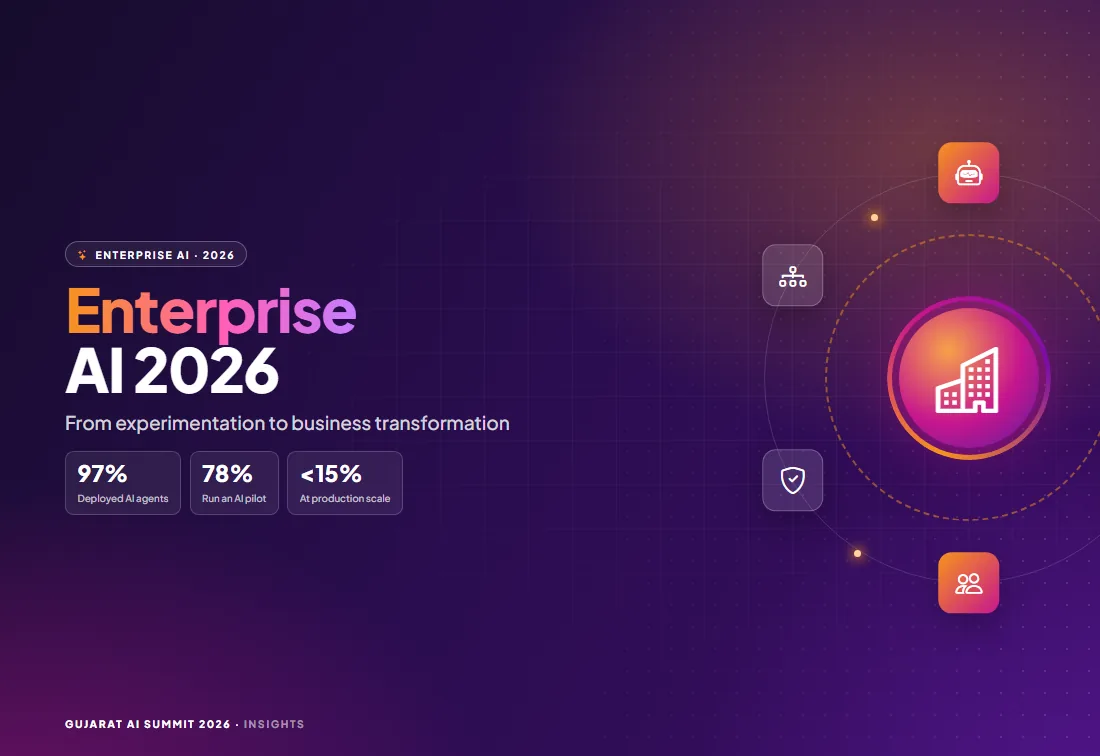 Read nextEnterprise AI in 2026: From Experimentation to Real Business Transformation